


30 October 2025
The fall of Bashar al-Assad’s regime in December 2024 presents a historic opportunity to integrate a comprehensive and inclusive transitional justice (TJ) process in Syria – one that ensures justice, reconciliation, and long-term stability.
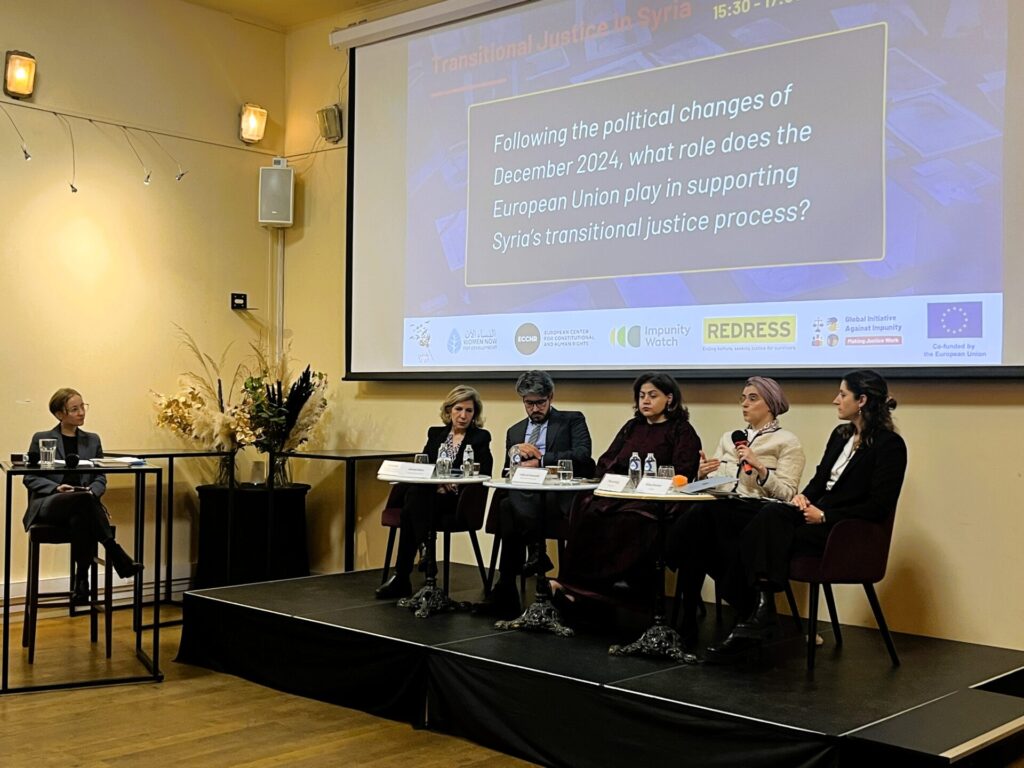
The European Union’s (EU) support is crucial in shaping a victim-centred transformation, but its involvement must be thoughtful, survivor-centred, and grounded in Syrian realities. On 16 October 2025, Syrian CSOs Ta’afi Initiative and Women Now for Development (WND), members of the Global Initiative Against Impunity (GIAI), and (INOVAS) came together to address the full spectrum of what this could look like.
Survivors at the heart of TJ in Syria
Joumana Seif, co-founder of the Syrian Women’s Political Movement and Senior Legal Advisor at ECCHR highlighted in her keynote address that:
“As long as we have a strong and resilient civil society, and as long as sustainable support is secured, meaningful progress remains possible. This hope is in large part associated with the tireless efforts of Syrian organizations and activists.”
She put forward ten recommendations on how the EU can help advance genuine national dialogue in Syria to rebuild social cohesion, and establish sustainable peace. These include:
- Supporting economic revitalization to address poverty and the lack of jobs, which drives violence
- Supporting a survivor-centred TJ process, including what support victims and families should receive (e.g. psychosocial support, reparations)
- Supporting women-led civil society organizations and women human rights activists
- Supporting the reform and independence of the judiciary, including by promoting the inclusion of female judges
- Encouraging the government to adopt a gender-sensitive approach within law enforcement and defense institutions
- Ensuring that the design and implementation of the accountability process is Syrian-led including the vital role of civil society
- Supporting the collaboration among the National Commission for Transitional Justice, the Syrian judicial system, and international institutions with extensive experience in the Syrian context, such as IIIM, COI, and IIMP, is essential
- Supporting continued trials and investigations in Europe under Universal Jurisdiction
- Providing technical support for preserving and documenting evidence
- Encourage and support the government to ensure women’s inclusion in full alignment with UNSC Resolution 1325 on Women, Peace, and Security
Ahmad Helmi of Ta’afi Syria highlighted that the ‘General Principles for Applying Truth, Justice, and Remedy in Syria’, a document putting forward the collective perspective of civil society and survivor groups, is a strong step forward to “make TJ accessible by every Syrian household.” This can be further bolstered by integrating victim participation in other processes, such as the recent use of the INOVAS Guidelines on Victim Participation in training members of the National Commission for TJ.
Lubna Al kanawati from Women Now for Development pointed to the importance of making space to not just listen to, but validate survivors’ testimonies. For example, the report “The ongoing crime: A contextual feminist analysis of the crime of chemical Weapons in Eastern Ghouta” is a trauma-sensitive piece of in-depth research which amplifies the voices of survivors and the lasting harm of the 2013 chemical weapons attack in Syria and the specific experiences of women. This research was crucially utilised as evidence by the Paris Judicial Court to support the case against the regime’s use of chemical weapons. This proves that women’s leadership is essential for truth-telling, supporting survivors, and rebuilding Syrian society on inclusive foundations.
So what role do international actors play?
Mouna Khaity from Impunity Watch suggests that in a context like Syria, where the relationship between citizens and the State is broken, Syrians must come together to re-define Transitional Justice on their own terms. This is because:
“EU frameworks are seen as imposed, fragmented, and often sideline Syrians. Transitional Justice in Syria is a process, not a checkbox.” – Mouna Khaity, Impunity Watch
She continued by saying that international NGOs must be aware of our positionality as international actors at this moment. With Syrians being the main drivers and visionaries of TJ in the country, who have already laid the groundwork for decades, INGOs’ crucial role is to pressure international actors to protect their civic space, and amplify the recommendations of local partners. There are a few core ways to lend this support: asset recovery for reparations, and strengthening universal jurisdiction.
Reparations and asset recovery: A justice imperative
One of the most actionable ways the EU can support TJ efforts in Syria is through asset recovery, a key focus for REDRESS. It’s estimated that the Assad regime controlled billions of dollars in assets – much of which is currently frozen under sanctions (including EU sanctions).
How can the EU and its member states use asset recovery to make the right to reparations a reality for Syrians? Olivia Dehnavi of REDRESS explains, through the launch of a new policy paper on this topic, that there is promising progress being made to trace and seize illegal assets linked to those responsible for serious human rights violations:
- France and the UK: $300 million in stolen public funds confiscated
- Spain: Proceedings underway to seize up to €700 million
- Case against Lafarge: $800 million in penalties agreed to hold corporate actors accountable for financially supporting ISIS in its genocide against Yazidi communities
This brings to light the immense potential to lawfully recover illicit assets and direct them towards reparations for victims of war crimes and helping rebuild Syria. The EU can achieve this by: supporting confiscation proceedings; enforcing sanctions regimes; and collaborating with Syrian survivors and civil society to explore further mechanisms for delivering reparations.
It was further emphasised that “reparations should not be in conflict with the past and future economic recovery – they go hand in hand. … For Syrian society to have confidence in the Transitional Justice process, we need to be able to own it.” – Ahmad Helmi, Ta’afi Syria, co-founder of INOVAS
From Universal Jurisdiction to holistic justice
Amid hopes for justice, accountability and a democratic transition from within Syria, impunity remains a risk. Criminal accountability is a key demand of survivors and civil society, and building on the EU’s track record of Universal Jurisdiction (UJ) cases plays an important role in filling impunity gaps.
The ECCHR’s latest policy paper, ‘Promoting criminal accountability and transitional justice in Syria: The role of the EU’ explains that while the EU must renew its long-standing political commitment to accountability, they cannot substitute for a Syrian-led process. Florentina Pircher from ECCHR discussed the paper’s recommendations, which showcase where and how EU support can strengthen the work of national actors:
- Commit to long-term and sustainable funding
- Recognize and enhance the role of civil society
- Advance criminal accountability (including through UJ, hybrid tribunals, and national mechanisms)
- Strengthen Syrian judicial capacity
“Syria stands at a historic crossroads to unite and transition to democracy. This chance may not come again. … I urge the international community to provide these resources and training, and to support the rehabilitation of our judicial system.” – Joumana Seif, ECCHR, Syrian Women’s Political Movement, and Member of Syrian Transitional Justice Commission
It is clear that for a meaningful and sustainable TJ process to thrive in Syria, it cannot be imposed; it must be designed for Syrians by Syrians. This means ensuring that their rights and demands drive accountability efforts so that ongoing investigations and prosecutions abroad are linked to, and reinforce, national processes. These must be coupled with reparation for victims, which can be achieved through asset freezes that recover and repurpose illicit assets and channel them into victim reparations.
By combining these strands, the EU can help lay the foundations for justice, reconciliation, and long-term stability in Syria.
**
The Global Initiative Against Impunity for International Crimes and Serious Human Rights Violations (GIAI), or MakingJusticeWork.org, is a civil society-led initiative, co-funded by the European Union to strengthen justice and accountability for serious human rights violations worldwide.
Several consortium members – including the European Center for Constitutional and Human Rights (ECCHR), Impunity Watch, and REDRESS – have had long-standing collaborations with Syrian civil society, survivor-led and family associations, and women-led organisations. Over the past decade, they have documented violations, sustained accountability efforts and grassroots-led initiatives, amplified their demands in international forums, and laid important groundwork for future justice processes in severely restricted times. This has meant that Syrian voices, experiences, and leadership now form the basis of a credible and legitimate justice process. EU investment in this work has ensured that victims and survivors remain central to shaping Syria’s transitional justice pathway.
Download this article. Find out more about our work in Syria.